

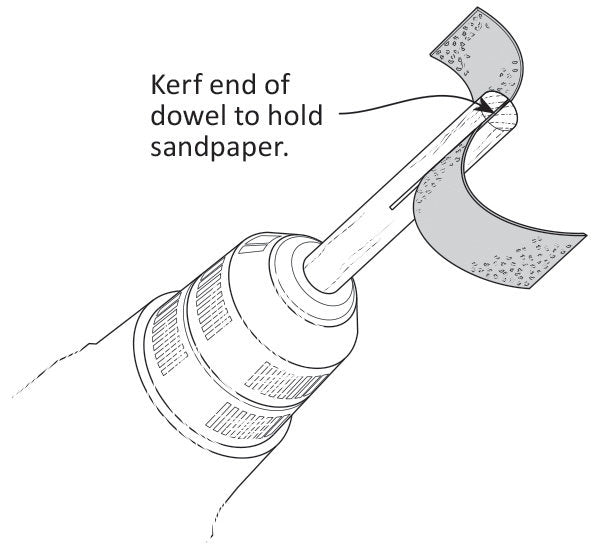
When smoothing concave edges, particularly in confined areas, I find that a dowel wrapped in sandpaper and chucked in a drill serves as a great mini drum sander of sorts. To make one, bisect one end of a short length of stout dowel using a bandsaw or handsaw, and insert a strip of sandpaper into the kerf. Then chuck the other end in a drill. The rotation of the drill as you work causes the paper to wrap around the dowel, creating the drum sander effect. The real beauty of this is that, when the paper wears, you simply tear off the used section to expose new grit and quickly get back to work.
—Bob Howard, Saint Louis, Missouri
Why This Shop Trick Is So Effective
What makes this homemade drum sander especially useful is its ability to conform to curves that rigid sanding blocks and flat abrasives can’t reach. Concave edges, inside radii, and sculpted details often require a tool that applies even pressure without flattening the shape. Because the sandpaper flexes naturally around the dowel as it spins, it follows the curve instead of fighting it, resulting in smoother, more consistent surfaces with less effort.
This approach is also highly adaptable. By changing the dowel diameter, you can fine‑tune the sander to match tight coves or broader curves, making it suitable for everything from furniture components to trim work and small craft projects.
Applications in the Shop
This technique is particularly handy when working on parts that are difficult to sand by hand or awkward to run across a stationary machine. It excels at smoothing:
- Inside curves on chair parts and table aprons
- Bandsawn profiles and scrollwork
- Routed grooves and decorative coves
- Small curved cutouts where larger sanders won’t fit
For woodworkers who frequently deal with shaped parts, having a few dowels prepped in different diameters can save time and reduce frustration during final surface prep.